
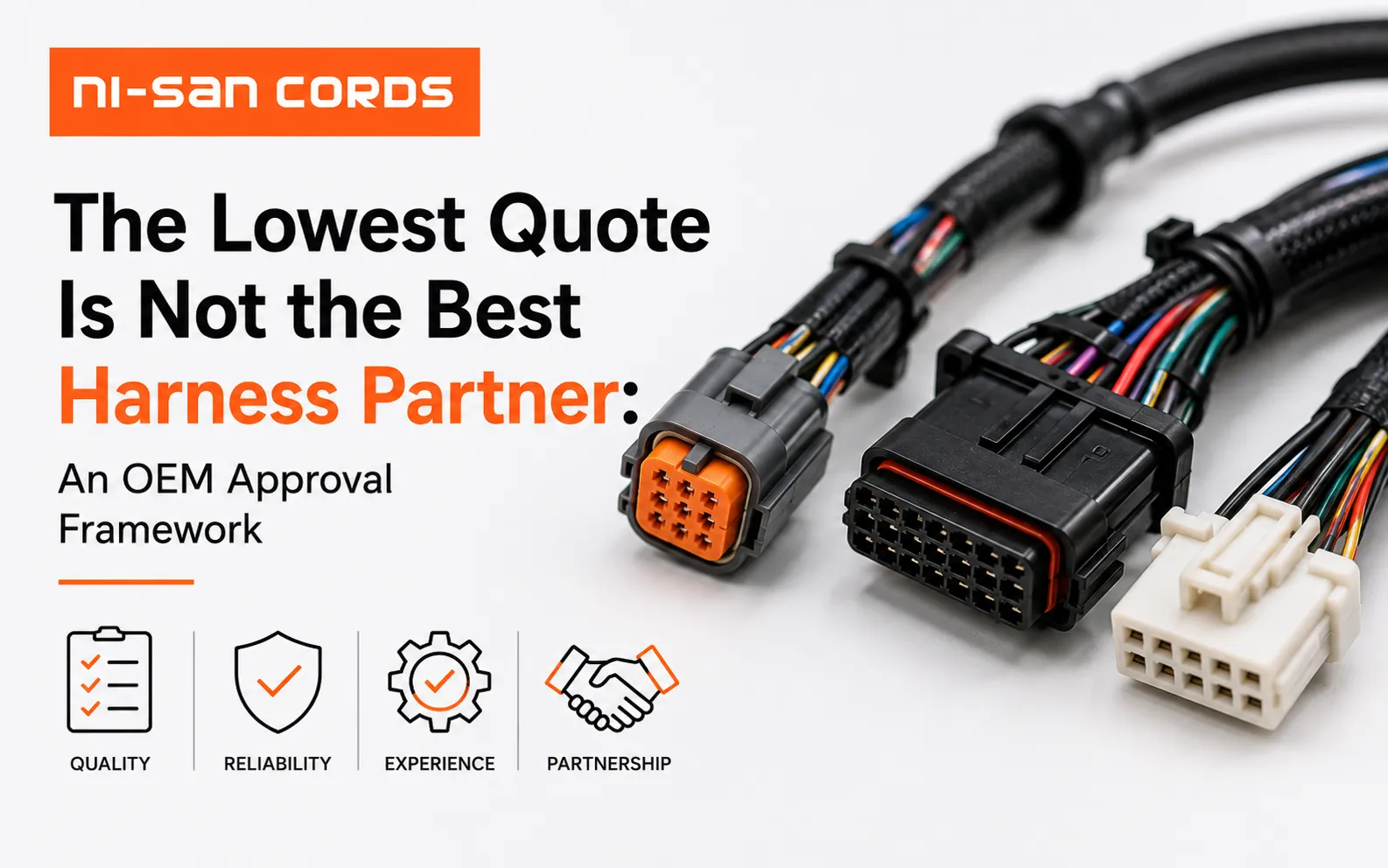
A wire harness supplier becomes part of the buyer’s production system. A late batch can stop assembly. One crossed wire can reach hundreds of finished products. Ni-San works as an OEM supplier for custom harnesses. Each buyer should check a vendor against product risk and volume. “Best” has no value unless it can be measured.
Check the Work, Not the Company Size
A large factory may still be unsuitable for a complex, low-volume harness. A small unit may build a good sample. It may struggle with steady bulk output. The right match depends on circuit count, wire size, connector type, branch layout, protection needs and order pattern.
Ask which products the supplier serves. Check that it can work from a wiring diagram, bill of materials and approved connector list. Agree on the approval route for any substitute.
Search results for best wire Harness manufacturers in India can create a shortlist. They cannot prove that a plant can make a buyer’s exact harness month after month.
Look Behind the Sample
A polished sample is only the first piece. During a review, follow the path from incoming wire to final packing.
Check how parts are identified and stored. Look at cutting, stripping, crimping, pin insertion, routing, taping and labelling. Ask how the team prevents a wrong terminal or similar-looking connector from reaching the workbench.
Crimp tools need set-up checks and upkeep. Work instructions should state strip length, crimp limits, terminal position and pull-test needs. The operator should also know what to do when a value moves outside the limit.
Prove That Each Circuit Works
Continuity testing should check the route from one pin to the correct end point. It should find open circuits, short circuits and crossed wires. Where polarity matters, the test plan must include it.
Mechanical checks matter too. Connector fit, lock position, branch length, clip location, pull strength and bend control can affect assembly. A harness that passes electrically may still fail to fit the product.
In April 2026, the Society of Indian Automobile Manufacturers reported total production of 29,22,427 units. The count covered passenger vehicles, three-wheelers, two-wheelers and quadricycles. At such scale, a low defect rate can create costly sorting, rework and field risk.
Test the Output Promise
Ask for normal output, plant load, shift plan, lead time and surge response. Capacity must be checked for the exact harness because circuit count and hand work change daily output.
Review minimum order quantity, tool cost, sample charge, packing, freight and payment terms. Also agree on stock ownership when custom connectors have long lead times. The lowest piece rate may hide high tooling, excess stock or weak delivery cover.
Score the Maker on Repeat Work
A useful scorecard can cover five areas: design fit, process control, test proof, delivery strength and clear terms. Give quality and delivery more weight than claims. Record gaps, owners and due dates before approval.
The purchase order should quote the correct drawing and bill-of-material revision. No change in wire, terminal, connector or route should enter production without written consent.
Nisan Cords states that its Pune unit follows wiring-diagram-led production, skilled hand assembly, continuity testing and connector-fit checks. That claim supports a first review, not a fixed ranking. The strongest supplier is the one that proves fit, control and repeat output for the buyer’s own product.